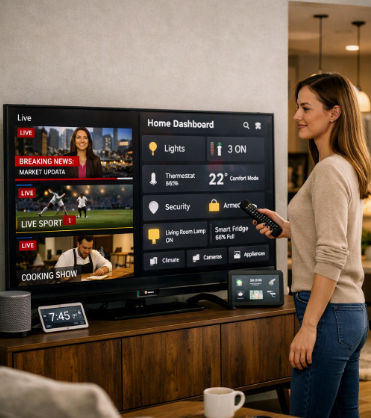
De‑Framing the App‑Grid: How V AIOS Reshapes Smart TV Architecture
For more than a decade, Smart TV innovation revolved around tile layouts, app stores, and UI speed. But at IFA 2026 in Berlin, Hisense signaled a shift in how TV platforms organize content and connected experiences. Under the banner of Companion Living, V AIOS, the next evolution of VIDAA OS, moves beyond pure app navigation toward unified context, integrated discovery, and background intelligence.
V AIOS is structured around four core AI capabilities: Sense, Think, Communicate, and Execute. Instead of functioning solely as a launcher for third‑party streaming apps, the OS uses these pillars to streamline search, surface personalized content feeds, and coordinate basic smart home tasks.
Major SVOD platforms like Netflix, YouTube, and Disney+ remain central to the Smart TV experience. What changes with V AIOS is the reduction of friction between them.
By combining natural language processing in 28 languages with on‑device intent recognition, V AIOS aggregates recommendations across streaming services and linear channels. This allows users to find content without manually opening individual apps.
Through Hisense’s ConnectLife platform, the TV becomes a convenient dashboard for compatible smart appliances. Users can check oven status, monitor laundry cycles, or adjust HVAC settings directly from the TV interface. Multi‑appliance orchestration is still emerging, but V AIOS establishes a foundation for unified home management.
These capabilities are enabled by the industry‑wide adoption of dedicated Neural Processing Units (NPUs) inside modern TV System‑on‑Chips (SoCs). In 2026, NPUs focus on practical, low‑latency tasks:
Present Capabilities
Real‑time frame optimization (AI upscaling, scene analysis)
Localized Small Language Models (SLMs) for responsive voice control
Basic presence and environment detection via built‑in light and acoustic sensors
To keep live TV navigation fast and app‑free, V AIOS incorporates open ETSI specifications such as DVB‑I and HbbTV. DVB‑I Service List Registries allow the OS to populate channel guides directly at the system level, while HbbTV provides interactive layers for broadcasters. Together, they reduce fragmentation and unify linear discovery inside the OS.
By combining local NPU processing with open discovery standards, V AIOS points toward a more integrated Smart TV architecture, one where apps remain essential, but the friction of navigating them is quietly minimized. The result is a platform that treats content and connected devices as part of a single contextual environment rather than isolated destinations.